I was on a call yesterday with Benjamin Baxter, a content strategist who helps B2B founders with LinkedIn. We were supposed to be planning something technical, but the conversation went somewhere more interesting.
Ben mentioned that the biggest tell of AI-generated content is “vague generalities that aren’t based in any personal experience.” The classic “I was talking to a billionaire…” posts that everyone knows are made up.
It made me think about a CEO I worked with years ago.
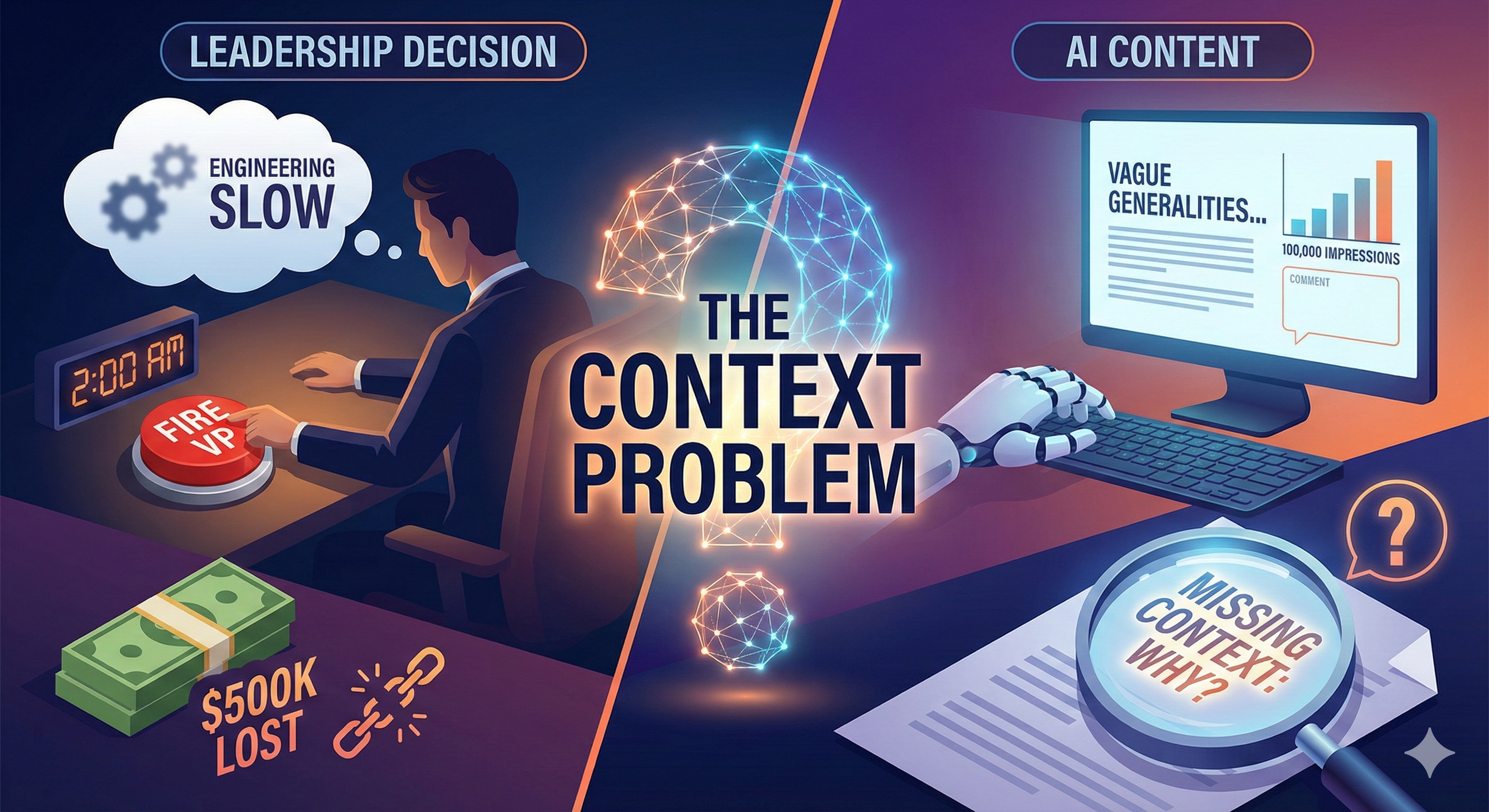
The 2 AM Decision
It started at a Friday board meeting. Someone asked: “Why is engineering so slow?”
By Saturday, the CEO was doubting his VP of Engineering.
By Sunday, he’d convinced himself it was a people problem.
Tuesday at 2 AM, he fired the VP.
Three months to find a replacement. Two months to onboard them. The same problems were still there. Over $500K in cost and lost momentum. Team trust damaged for years.
The real problem was never the person. It was misaligned expectations between leadership and engineering. They were measuring velocity instead of customer outcomes. No cross-functional collaboration framework. Product and engineering in silos.
He made a critical decision alone, optimizing for being right and moving fast. He was wrong.
The Vanity Metric
Ben shared a similar pattern in content. One of his clients got 100,000 impressions on a LinkedIn post. Zero results.
Another post got 17,000 impressions. It drove 327 comments, 160 guide requests, three client calls, and $180K in pipeline.
The difference? The first post was trying to go viral. The second post was speaking to a real problem his ideal customers were facing, using his actual experience.
One optimized for impressions. The other optimized for resonance.
What’s Missing
Ben has an 1,800-line document with all his content best practices. But he’s frustrated because AI systems don’t always use the context correctly. He’ll see outputs that violate rules he explicitly defined.
Here’s what he said that stuck with me: “I don’t just need the system to know what I do. I need it to understand why I do it.”
The reasoning behind decisions. The experience that shaped perspective. The context that lives in your head.
That’s what makes expertise valuable. And that’s what gets lost—in AI content and in isolated decision-making.
The Pattern
Whether you’re creating content or making executive decisions, the most expensive mistakes come from the same place:
You’re optimizing for the wrong metric. Speed over quality. Impressions over impact. Being right over getting it right.
And you’re doing it without the context that matters.
The CEO needed someone at 2 AM who could ask: “What problem are you really solving? What might you be missing?”
The founder needed a filter that asked: “Is this speaking to a real problem, or are you just chasing virality?”
What Actually Matters
Ben won’t launch his content tool until he’s using it himself and finding it genuinely valuable. He calls it the “dog food test.”
I respect that. It’s honest.
After 25 years in software engineering and leadership, I’ve learned that the best solutions come from people who’ve faced the problem themselves. Not people selling you a framework they’ve never used.
The CEO’s mistake cost $500K and years of damaged trust. The founder’s viral post cost opportunity and credibility.
Both could have been avoided with better context and better questions.
The lesson? Don’t optimize for metrics that don’t matter. Don’t make critical decisions—or create critical content—without challenging your own thinking. And don’t mistake speed for progress.
Sometimes the most valuable thing is someone who asks you a better question.